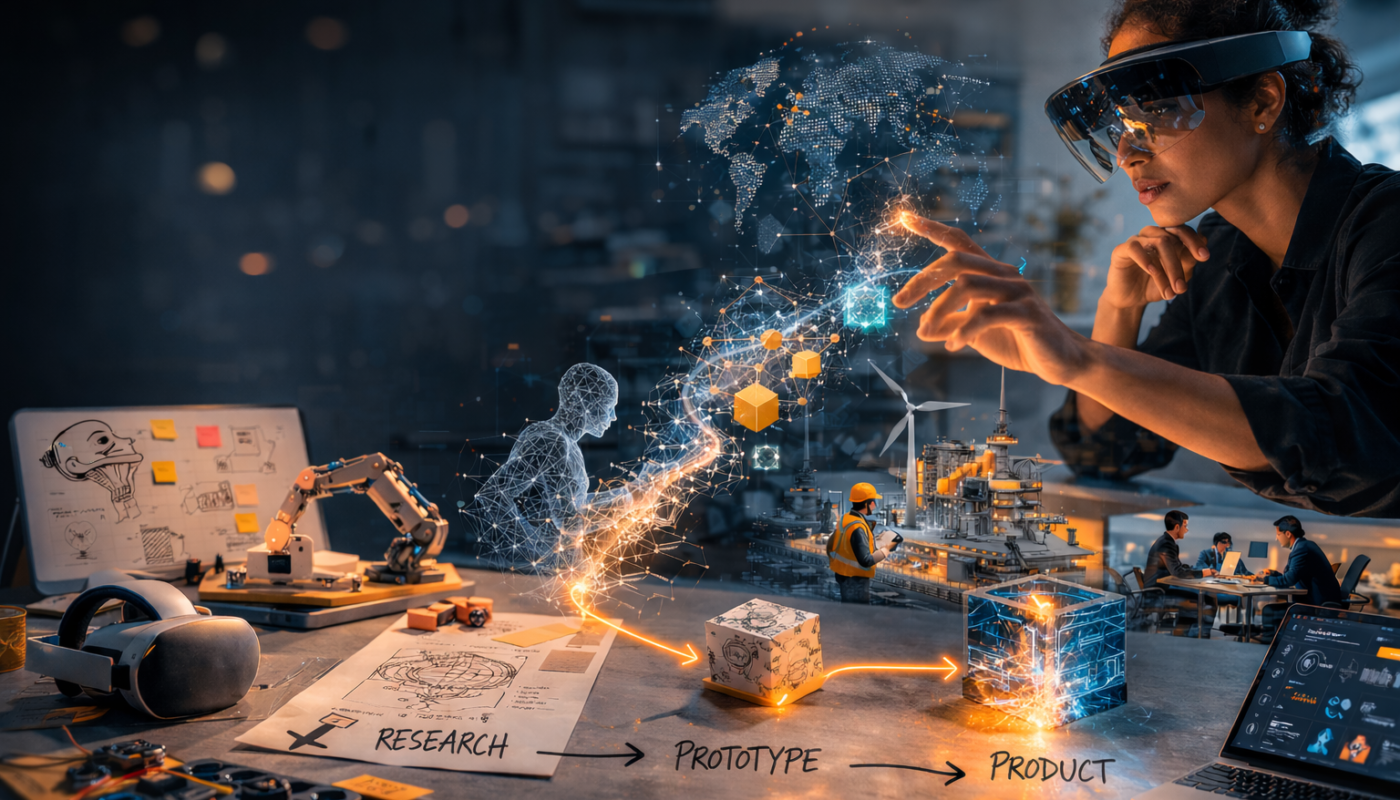
Bridging the gap between breakthrough research and real-world adoption in artificial intelligence, spatial computing, and extended reality.
Introduction
Across research laboratories, technology startups, and corporate innovation units worldwide, the promise of frontier technologies continues to inspire enormous investment. Artificial intelligence, extended reality (XR), spatial computing, digital twins, and adaptive human-computer interfaces are widely viewed as the next major computing platforms.
Yet despite remarkable technical progress, many deep-tech innovations fail to translate into durable products.
The pattern is surprisingly consistent. A breakthrough emerges from a research lab. Early demonstrations are compelling. Investors and executives envision transformative applications. Teams expand, prototypes evolve, and pilot deployments begin.
But somewhere between proof-of-concept and scalable product, momentum slows.
Adoption takes longer than expected. Customers hesitate. Integration proves harder than anticipated. Costs accumulate faster than revenue. In some cases, organizations eventually restructure or reduce investment after realizing that commercialization timelines were overly optimistic.
This has been visible in several high-profile areas of frontier technology. Even major companies with deep expertise and large R&D budgets have had to recalibrate their immersive computing and advanced technology strategies when adoption proved slower than expected. The lesson is not that these technologies lack potential. Rather, it highlights a deeper challenge:
Deep-tech innovation does not fail because the science is weak.
It fails because commercialization is hard.
Understanding this gap between research breakthrough and market value is one of the most important strategic challenges facing technology leaders today.
The Commercialisation Gap in Frontier Technology
At the heart of the problem lies a fundamental mismatch between how research is created and how products succeed in markets.
Research environments reward novelty, discovery, and performance improvements. Success is measured through publications, patents, prototypes, or demonstrations of technical capability.
Markets reward something very different: reliability, usability, integration, and measurable business value.
This mismatch is particularly pronounced in emerging fields like XR and AI, where the underlying technology can be extraordinary but the pathways to adoption remain complex.
In artificial intelligence, many organizations have demonstrated powerful models and generative systems. However, scaling these capabilities into enterprise workflows often requires solving challenges around data governance, system integration, reliability, and trust.
In extended reality, immersive experiences can be visually stunning and technically sophisticated. Yet commercial adoption depends on factors that extend far beyond rendering performance: device comfort, workflow integration, content pipelines, enterprise IT management, and clear economic return.
As a result, many promising innovations stall in what might be called the “translation layer” between research and productization.
Five Reasons Deep-Tech Innovation Stalls
Through years of observing frontier technology programs across academia, industry labs, and startups, several recurring patterns emerge.
1. Technology Advances Faster Than Ecosystems
Deep-tech innovation rarely exists in isolation. Successful products depend on surrounding ecosystems: developer tools, hardware supply chains, user behavior patterns, regulatory frameworks, and compatible infrastructure.
When even a few of these elements lag, adoption slows dramatically.
XR provides a useful example. Immersive technologies have improved enormously over the past decade, but widespread adoption still depends on device affordability, comfortable form factors, content ecosystems, and enterprise deployment frameworks.
When ecosystem maturity lags behind technological capability, commercialization timelines stretch.
2. The Technology Solves Interesting Problems — Not Painful Ones
Research teams often pursue intellectually fascinating challenges. Markets, however, prioritize problems that cause measurable operational pain.
The most successful deep-tech deployments tend to focus on highly specific, high-value use cases.
For example:
- Industrial training simulations
- Medical visualization and surgical planning
- Engineering design collaboration
- Maintenance and repair workflows
These contexts provide clear economic incentives for adoption because they improve efficiency, reduce errors, or accelerate training outcomes.
When innovations lack such tangible value propositions, they struggle to move beyond experimentation.
3. Organizations Underestimate Change Management
Deploying frontier technology is rarely just a technical project. It is an organizational transformation.
New systems often require:
- redesigned workflows
- new governance processes
- training programs for employees
- adjustments to operational responsibilities
- integration with existing enterprise systems
Without careful change management, even technically excellent solutions can encounter internal resistance or operational friction.
Technology adoption succeeds when organizations invest not only in building systems, but also in making them usable within real work environments.
4. Business Cases Are Built on Vision Rather Than Evidence
Strategic narratives often drive early investment in emerging technologies.
Statements such as “AI will transform knowledge work” or “spatial computing will redefine collaboration” may be directionally correct, but they do not automatically translate into near-term product demand.
Successful commercialization requires narrow proof before broad scaling.
Organizations that expand teams, infrastructure, and marketing based on projected future demand sometimes discover that adoption arrives more slowly than expected. When this occurs, restructuring or layoffs may follow—not because the technology lacks potential, but because commercialization curves were misjudged.
5. Teams Confuse Invention with Productization
Inventing something new is not the same as building something people will use.
Research prototypes prioritize exploration. Product systems prioritize stability, usability, and long-term support.
The transition from invention to productization requires new competencies:
- product design
- operational engineering
- customer support infrastructure
- regulatory and compliance considerations
- lifecycle maintenance
Organizations that lack this translation capability often produce impressive prototypes that never mature into sustainable products.
When Innovation Moves Faster Than Adoption
One of the most visible consequences of commercialization gaps is organizational realignment.
When companies invest heavily in emerging technologies, they often do so based on expectations about future platform shifts. If adoption unfolds more slowly than anticipated, those investments may need to be recalibrated.
This pattern has appeared across multiple areas of frontier technology, including immersive computing and advanced development platforms. In some cases, companies have scaled back teams, redirected resources, or narrowed focus areas as they refine their strategies.
Such adjustments should not necessarily be interpreted as failures of the technology itself. Instead, they reflect the realities of bringing complex innovations to market.
Deep-tech adoption is rarely linear.
What Successful Deep-Tech Commercialisation Looks Like
Organizations that successfully commercialize frontier technologies typically follow a disciplined pathway.
Rather than attempting to leap directly from research breakthrough to large-scale deployment, they move through several structured phases.
Identify High-Value Use Cases
Successful innovations begin with specific operational problems that customers already recognize.
Rather than pursuing broad “platform visions,” early deployments often focus on narrowly defined workflows where the technology creates measurable improvements.
Demonstrate Operational Value
Proof of concept must evolve into proof of value.
This means identifying concrete performance metrics, such as:
- training efficiency
- task completion speed
- cost reduction
- safety improvements
- productivity gains
When technology clearly improves measurable outcomes, adoption becomes easier to justify.
Integrate with Existing Systems
New technologies must coexist with existing infrastructure.
Successful products integrate seamlessly with enterprise tools, data pipelines, and operational processes rather than forcing organizations to reinvent their entire technology stack.
Minimize Behavioral Friction
Even powerful technologies fail when they disrupt user behavior too drastically.
Adoption improves when new systems:
- reduce complexity
- align with familiar workflows
- offer intuitive interfaces
- provide clear reliability and trust
Designing for human behavior is as important as designing for technical capability.
Scale Gradually
Deep-tech commercialization benefits from staged expansion.
Successful companies typically follow a path of:
- targeted pilots
- validated deployments
- operational refinement
- broader scaling
This approach ensures that investment levels match real adoption signals.
The Opportunity at the Intersection of AI and XR
While commercialization challenges remain, the long-term potential of AI and XR remains enormous.
The next generation of computing environments is likely to combine several capabilities:
- intelligent AI agents
- immersive spatial interfaces
- contextual sensing systems
- human-aware adaptive environments
In such systems, computing platforms will not merely display information. They will understand user context, behavior, and intent.
This evolution opens new possibilities across industries, including:
- healthcare training and diagnostics
- industrial operations and digital twins
- advanced simulation and education
- collaborative engineering environments
- human-aware productivity tools
However, realizing these opportunities requires more than technological breakthroughs. It requires effective translation between research innovation and market deployment.
The Role of Strategic Deep-Tech Translation
As frontier technologies grow more complex, the need for specialized translation between research and productization becomes increasingly important.
Many organizations possess extraordinary research capabilities but lack the operational frameworks needed to bring those innovations into production environments.
Others have strong product teams but limited visibility into emerging research frontiers.
Bridging these domains requires interdisciplinary expertise spanning:
- scientific research
- product strategy
- human-computer interaction
- enterprise systems integration
- market positioning
This is precisely where boutique deep-tech consultancies can play an important role.
The Future of Deep-Tech Innovation
The world does not lack bold ideas in frontier technology.
Universities, research labs, and innovation teams are producing remarkable breakthroughs in AI, XR, and human-computer interaction. The challenge is not generating new inventions. It is translating them into systems that organizations can deploy, scale, and trust.
The next decade of technological progress will likely be defined not only by scientific discovery but also by the ability to commercialize complex innovations effectively.
Organizations that master this translation layer will unlock enormous value.
Those that do not may continue producing impressive prototypes that never reach the market.
Conclusion
Deep-tech innovation represents one of the most powerful forces shaping the future of technology.
Yet innovation alone is not enough.
The real challenge lies in bridging the distance between research insight and real-world deployment—between laboratory breakthroughs and systems that improve how people work, learn, design, and collaborate.
At Embute Labs, we believe the most valuable technology initiatives are those that combine scientific depth with practical execution.
Because in deep tech, invention is only the beginning.
True impact begins when innovation reaches the real world.